Share
Network, Ecosystem & Community
Financial Institutions Need Compliance Infrastructure. Forta Firewall Delivers It.
January 27, 2026
•
Financial institutions are no longer just experimenting onchain. Real world assets like tokenized treasuries, commodities and credit funds are already moving on-chain, and traditional institutions are starting to use blockchains for settlement and asset management. As distribution expands, one requirement is becoming unavoidable: FI-capable chains must support regulatory compliance, sanctions controls and user protection.
This is where legacy financial rails and blockchain diverge. Banks, custodians and broker-dealers operate with screening, monitoring and control systems that enforce sanctions, protect customers and reduce counterparty risk. Most blockchains were not designed for that environment. The EVM stack does not natively screen OFAC-sanctioned actors, block drainer activity, enforce freeze directives or support consumer protection. Yet, these controls are necessary for regulated issuers, distributors and wealth platforms to interact with tokenized assets.
Forta Firewall fills this gap. Firewall screens transactions before execution and enables networks to enforce policy in real time. To date, Firewall has screened more than 780 million transactions across supported networks, with peaks surpassing five million screened transactions per day.
Forta Firewall for Safe & Compliant Financial Services
Chains such as Kraken’s Ink, Plume and Celo are already using Forta Firewall with tailored security and compliance configurations. Ink has screened more than 220 million transactions since activation, enforcing OFAC sanctions screening and freeze-list controls to block restricted activity while maintaining full network uptime. Plume uses Firewall to protect tokenized funds and private credit strategies through continuous exploit detection, sanctions screening, freeze controls and monitoring of high-risk clusters such as the Lazarus Group, screening over 2.5 million transactions per day. Celo has adopted Firewall as part of its broader compliance and security strategy, combining OFAC screening, and phishing prevention to safeguard users.
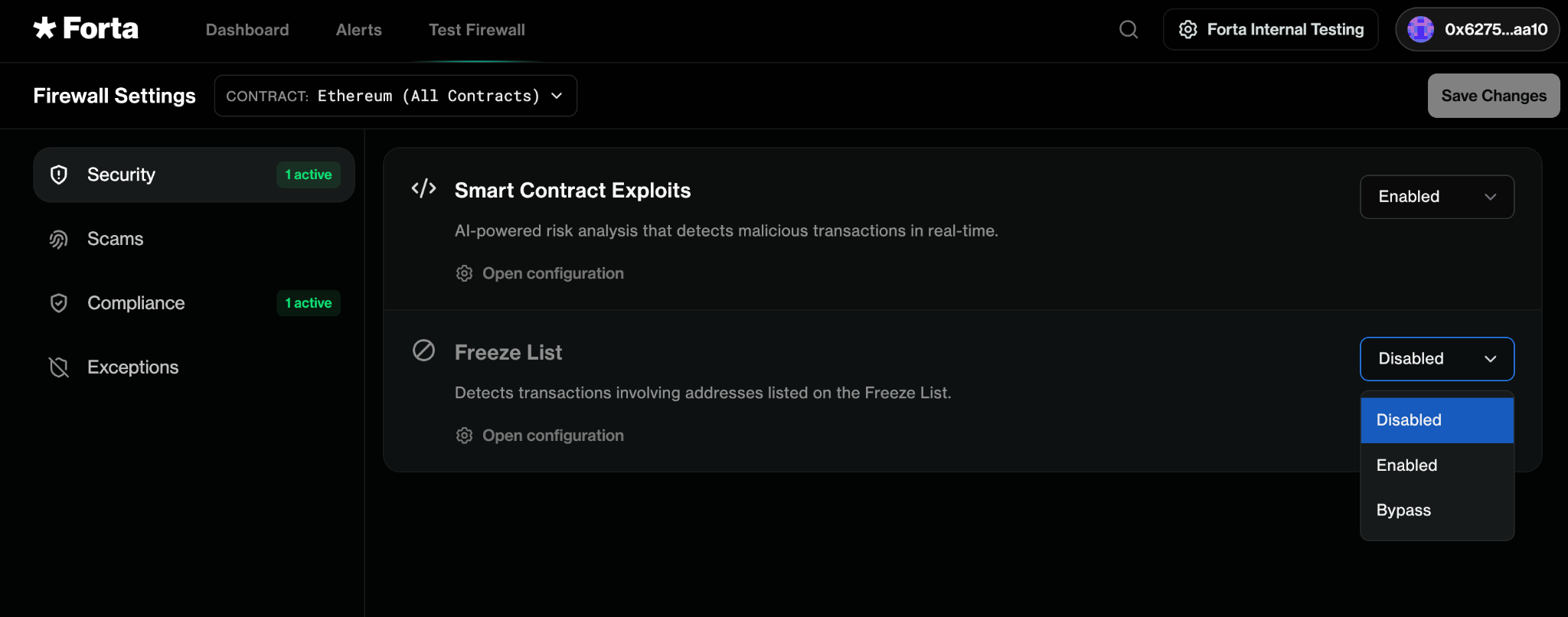
Sanctions and risk controls remain a core driver of institutional readiness. Firewall continuously ingests sanctions updates and maintains dynamic risk clusters, enabling real-time identification of sanctioned, fraudulent and high-risk entities. When flagged activity is detected on a Firewall-enabled chain, transactions can be blocked before execution. Further controls are enforced via a freeze list: a configurable set of off-limits addresses (e.g., known bad actors). If a transaction attempts to interact with one of them, Firewall can block it or alert instantly.
Consumer protection is equally important, as industrialized wallet-drainer ecosystems, including Inferno Drainer, Eleven Drainer, Vanilla Drainer and Purple Drainer, have siphoned millions via phishing, counterfeit tokens and malicious approvals. Firewall maintains intelligence on these clusters and blocks transactions before execution.
The Path Ahead for RWA Chains
The outcome is clear: RWAs cannot grow on networks that cannot demonstrate sanctions controls, fraud prevention, and drainer protection. As tokenized assets move from pilots into regulated distribution, compliant chains gain access while non-compliant chains are excluded. Firewall powered networks such as Ink, Plume, and Celo illustrate the emerging model: programmable compliance at the protocol layer, without sacrificing composability or settlement efficiency.
The next phase of on-chain finance will resemble financial market infrastructure: auditable, compliant and secure. Forta Firewall enables FI chains to meet those standards and safely connect regulated capital to programmable assets at scale.
.png)
.png)